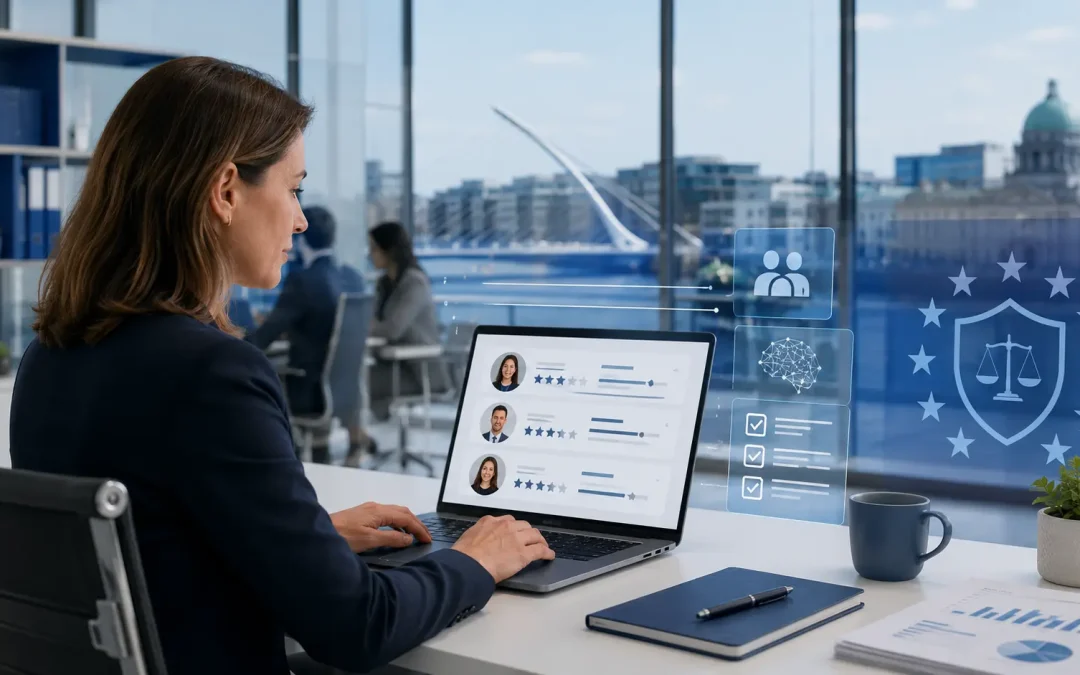
Most Irish small and medium-sized enterprises (SMEs) continue to hire on instinct. A strong curriculum vitae (CV) arrives, the interview runs well, and within weeks the new appointment begins to falter, whether through pace, team fit, or an underlying mismatch with the role.
Poor hiring decisions carry a substantial financial cost. Research widely cited by the Chartered Institute of Personnel and Development (CIPD) and the Society for Human Resource Management (SHRM), drawing on Oxford Economics analysis of replacement costs, places the full expense of a mis-hire at up to three times the employee’s annual salary once notice, lost productivity, management time, and re-recruitment are taken into account. For an organisation of 20 or 50 staff, that is not an expense that can be absorbed quietly.
Psychometric testing offers one method of reducing that risk, not by replacing human judgement, but by adding an objective, evidence-based layer to the hiring decision. Many Irish SMEs still regard it as something only multinationals use. This article sets out what psychometric testing involves, whether the evidence supports its use, and how smaller businesses in Ireland can adopt it without overcomplicating their recruitment process.
What Are Psychometric Tests, and How Are They Used in Recruitment?
Psychometric tests are standardised assessments designed to measure a candidate’s cognitive abilities, behavioural traits, or both. They are not personality quizzes drawn from social media. They are validated tools built on decades of occupational psychology research, and they are used to predict how a candidate is likely to perform in a specific role.
In a recruitment context, they fall into three broad categories.
Cognitive Ability Tests
Cognitive ability tests measure numerical reasoning, verbal reasoning, and problem-solving. They provide a reliable indication of how quickly a person can process information and learn new tasks, which in many roles matters more than prior experience, particularly where the job will evolve over time.
Personality and Behavioural Assessments
Personality and behavioural assessments explore how a candidate typically approaches work, including:
- Communication style
- Response to pressure
- Preference for structure or autonomy
- Patterns of team interaction
These assessments do not have right or wrong answers. They indicate whether a candidate’s natural working style aligns with the demands of the role and the culture of the organisation.
Situational Judgement Tests (SJTs)
Some providers also offer situational judgement tests (SJTs), which present realistic workplace scenarios and ask candidates to select a response. SJTs are particularly useful for customer-facing or management roles where decision-making under pressure is part of the job.
Critically, psychometric testing works best when it is used alongside other methods, structured interviews, reference checks, and practical work samples. It is not a standalone decision tool, and no reputable HR professional would recommend its use in isolation. Incorporated into a well-designed hiring process, however, it significantly strengthens the quality of the final decision.
Why Irish SMEs Are More Exposed to Hiring Mistakes
The dynamics of hiring in a small or medium-sized business differ fundamentally from those in a large corporation. In a company with 15 employees, a poor hire does not just affect a department; it affects the whole business. There is no reserve capacity to absorb the workload, no HR department to manage the fallout, and no budgetary buffer in which to write off the cost.
Irish SMEs face specific pressures that compound this exposure. Staff turnover in Ireland has consistently exceeded the European average, with CIPD Ireland’s HR Practices in Ireland survey reporting elevated turnover in recent years, driven by cost-of-living pressures and limited career progression in smaller firms. When employees leave, SMEs face pressure to backfill quickly, and speed often comes at the expense of rigour.
Many SME owners conduct recruitment themselves or delegate it to office managers who, understandably, have no formal training in selection methods. Interviews tend to be unstructured conversations rather than competency-based assessments, and references are often treated as a formality. The result is a process that feels efficient but is statistically unreliable.
The picture across Ireland is not uniform. A Dublin-based technology SME competing with multinationals for software engineers, a regional manufacturing business recruiting a plant manager in the midlands, and a hospitality operator in the west each face different labour-market dynamics. What unites them is the absence of selection infrastructure capable of testing whether a candidate can actually perform the role.
What the Evidence Says About Psychometric Testing
The research base behind psychometric testing is unusually strong compared to most management practices.
The Schmidt and Hunter Meta-Analysis
The landmark meta-analysis by Schmidt and Hunter, “The Validity and Utility of Selection Methods in Personnel Psychology”, published in Psychological Bulletin in 1998, reviewed 85 years of personnel selection research and found that general cognitive ability tests are among the strongest single predictors of future job performance across virtually all occupations and industries. A 2016 update by Schmidt, Oh and Shaffer extended the dataset to 100 years of research findings and broadly confirmed the earlier conclusions.
The Sackett et al. Critique
More recently, Sackett, Zhang, Berry and Lievens (2022), writing in the Journal of Applied Psychology, revisited the statistical corrections used in that tradition and argued that some validity estimates may have been systematically overstated. The critique does not overturn the central finding that structured, validated selection methods outperform intuition-based processes; it does indicate that the research at the margins remains contested.
Incremental Validity
Personality assessments, while less predictive on their own, add substantial value when combined with cognitive tests and structured interviews. Together, these methods produce what researchers term “incremental validity”: each tool captures something the others miss, and the combination produces a significantly more accurate picture of a candidate than any single method alone.
For SMEs, where every hire carries outsized impact, improvements in hiring accuracy translate directly into reduced disruption and better business outcomes. The gap in Irish adoption is not in the evidence but in accessibility. Smaller businesses often assume these tools are too expensive, too complex, or designed for high-volume corporate hiring. That assumption is no longer accurate.
Which Types of Psychometric Assessments Suit SME Hiring?
Not every role warrants a full battery of tests. Part of using psychometric assessment effectively is choosing the right tool for the specific hiring challenge.
Cognitive Ability Tests
Most suitable for roles where learning speed, analytical thinking, or numerical accuracy matters, such as finance, operations, project management, or technical positions. These tests are administered quickly, often within 20 to 30 minutes, and produce a clear, comparable score across candidates.
Widely used instruments include:
- SHL’s Verify range, including numerical, verbal, and inductive reasoning tests
- Saville Assessment’s aptitude suite
- Cubiks’ Logiks series
Personality and Behavioural Profiles
Most useful for leadership roles, client-facing positions, or roles where cultural fit and interpersonal dynamics are critical. These assessments indicate how a candidate manages pressure, communicates, and collaborates, characteristics that rarely surface in a 45-minute interview.
Commonly deployed tools include:
- The Occupational Personality Questionnaire (OPQ32) from SHL
- Saville Wave
- The Hogan Personality Inventory and Hogan Development Survey
- Thomas International’s Personal Profile Analysis
Situational Judgement Tests
Best suited to roles with a strong decision-making component, such as team leads, customer service managers, and operational staff who exercise judgement independently. SJTs are particularly helpful where the correct response is not immediately obvious and where considered judgement under pressure is part of the job.
For most Irish SMEs, a combination of one cognitive test and one personality profile provides the practical balance. It adds meaningful data to the hiring decision without converting recruitment into an administrative exercise. A trained HR consultant or occupational psychologist can determine which combination is appropriate for the specific role.
Legal and Compliance Considerations in Ireland
Using psychometric testing in Ireland engages obligations under equality law, data-protection law, and professional accreditation standards. Each should be considered before testing begins.
Employment Equality
Under the Employment Equality Acts 1998 to 2015, employers are prohibited from discriminating at any stage of the recruitment process on any of the nine protected grounds:
- Gender
- Civil status
- Family status
- Sexual orientation
- Religion
- Age
- Disability
- Race
- Membership of the Traveller community
The Traveller community ground is specific to Ireland and has been considered in determinations involving selection processes. Psychometric tests must therefore be validated, job-relevant, and applied consistently to all candidates for the same role. A test that produces adverse impact on a protected group, without an objective job-related justification, may give rise to a complaint of indirect discrimination.
The Workplace Relations Commission (WRC) has jurisdiction over complaints of discrimination in selection processes, including those arising from the design or application of aptitude and psychometric testing. Employers are expected to be able to demonstrate the validity and job-relatedness of any assessment relied upon.
Data Protection
Psychometric test results are personal data and, in certain cases, may constitute special-category data. The Data Protection Commission (DPC) is the competent supervisory authority in Ireland for the General Data Protection Regulation (GDPR). Employers must therefore address:
- Lawful basis for processing: identifying an appropriate Article 6 ground, and, where special-category data arises, an Article 9 condition.
- Transparency: informing candidates at the point of testing how results will be used, who will see them, and how they will feed into the hiring decision.
- Retention: setting a defined retention period proportionate to the purpose, and securely deleting results once that period has expired.
- Data-subject rights: ensuring candidates can exercise their rights of access, rectification, and, where appropriate, erasure in relation to their test data.
Test Accreditation
In Ireland, the Psychological Society of Ireland (PSI) is the representative professional body for psychologists, including those practising in occupational psychology. PSI does not, however, maintain a dedicated test-user certification register in the same form as the British Psychological Society (BPS). For that reason, Test User (Occupational, Ability and Personality) qualifications issued by the BPS are widely held among occupational psychologists practising in Ireland and provide an internationally recognised standard for the safe and competent use of assessments. Many reputable providers also rely on the European Federation of Psychologists’ Associations (EFPA) test review framework.
Employers engaging external providers should satisfy themselves that the administrator, interpreter, and underlying instrument each meet these recognised accreditation standards.
The Cost Question: Testing Against the Cost of a Poor Hire
Professional psychometric assessments typically range from €150 to €500 per candidate, depending on the tools used and whether interpretation is included. For a senior hire, a more comprehensive assessment with a detailed report and debrief by a qualified psychologist generally costs between €600 and €1,000. That is a meaningful expense when hiring for a single role.
Worked Example: An Operations Manager Appointment
Consider an SME appointing an Operations Manager on a base salary of €70,000. A full senior-level psychometric assessment at the upper end of the range adds approximately €1,000 to the recruitment spend. If the appointment fails within the first year, the employer faces a series of direct and indirect costs:
- Statutory minimum notice or payment in lieu, under the Minimum Notice and Terms of Employment Acts 1973 to 2005 and can be even higher if the contract states a higher than Stature notice period where 3 months’ notice can be the norm.
- Recruitment fees on the second attempt, commonly 15 to 25 per cent of base salary for a senior search.
- Lost productivity during the underperformance period and the interim before the replacement is in post.
- Management time absorbed by performance management, exit, and re-hiring.
For a senior role, the combined direct and indirect cost can reach a material multiple of annual salary, consistent with the SHRM and Oxford Economics research referenced above. On that basis, a €1,000 assessment that prevents even one such failure per business cycle delivers a clear return.
Supports for SMEs
Support structures for SMEs seeking to invest in better selection practice are also available. Skillnet Ireland funds sector-specific training networks that routinely include recruitment and people-management courses, and the Local Enterprise Offices provide mentoring and HR-related supports to smaller businesses.
Making Smarter Hiring Decisions
Irish SMEs cannot reasonably continue to hire on instinct alone. The labour market is competitive, the financial consequences of mistakes are real, and the tools to make better decisions are more accessible than many business owners realise.
Psychometric testing does not remove the human element from hiring. It provides the human decision-maker with better information. When structured interviews are combined with validated assessments, the process moves from hope to evidence, producing a substantiated expectation that the chosen candidate is likely to succeed.
A conversation with an experienced HR partner can help an SME assess where psychometric testing fits in its recruitment process, and how to make it work within budget and timeframe.
HRP Group can provide bespoke psychometric testing as part of its Recruitment Process Outsourcing (RPO) service.
To discuss your hiring process or a particular hiring need, contact HRP Group on 01 676 0006 or at info@hrpgroup.ie.